
One-day and fast-return systems
Polyaspartic Floor Coating in Bethlehem, PA
A coating that cures in hours, holds its color in sunlight and can be applied in cooler weather than standard epoxy.
- Free on-site estimate with a slab moisture test
- Itemized written quote that lists every coat
- Concrete ground and repaired before any coating
When Fast Cure and UV Stability Matter
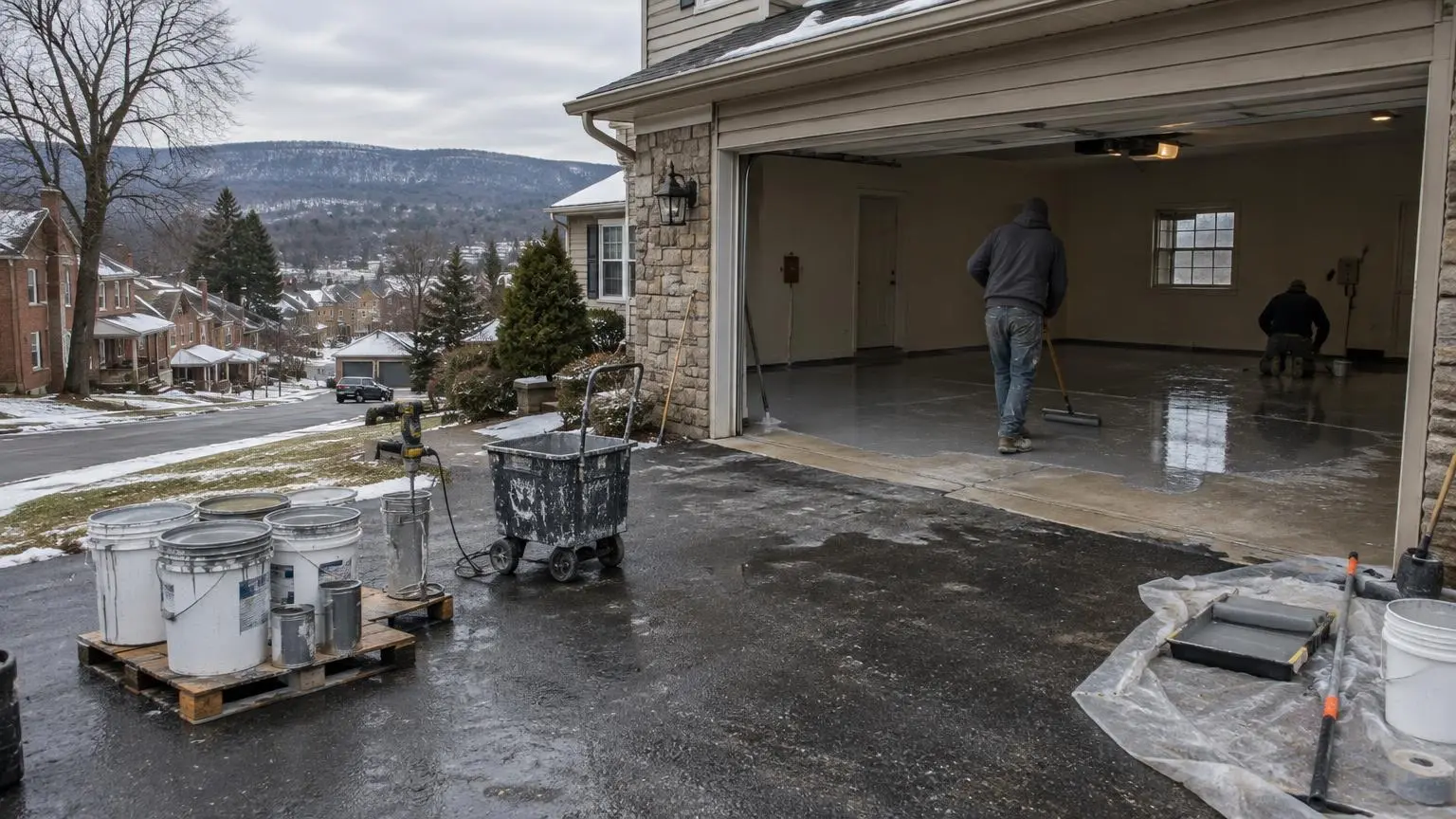
Polyaspartic floor coating is a type of polyurea that cures much faster than epoxy and does not yellow in sunlight. For Bethlehem homeowners it answers two common questions: how soon can I use my garage again, and can the work be done when the weather turns cold? HomeGuide lists a full cure for polyaspartic in one to two days, compared with up to a week for epoxy. It also lists an application range of -30°F to 140°F for polyaspartic, where epoxy has a narrower window. In a valley where January highs average 37°F, that range is useful.
How it compares with epoxy
- Cure time: Bob Vila's guide says polyaspartic is walkable in about 3 to 4 hours and ready for vehicles in about 24 hours. Standard epoxy takes at least 12 hours for foot traffic and about three days for vehicles.
- UV stability: HomeGuide rates polyaspartic's UV resistance as excellent and epoxy's as poor to fair. Epoxy can amber where sunlight hits it.
- Build and bond: epoxy builds thicker per coat and has a long working time that lets it soak into ground concrete. Many of our systems use an epoxy base with a polyaspartic topcoat to get both.
- Lifespan: HomeGuide puts polyaspartic at 10 to 20+ years and solid epoxy at 10 to 20 years, with water-based epoxy at 3 to 5 years.
Full polyaspartic or a hybrid
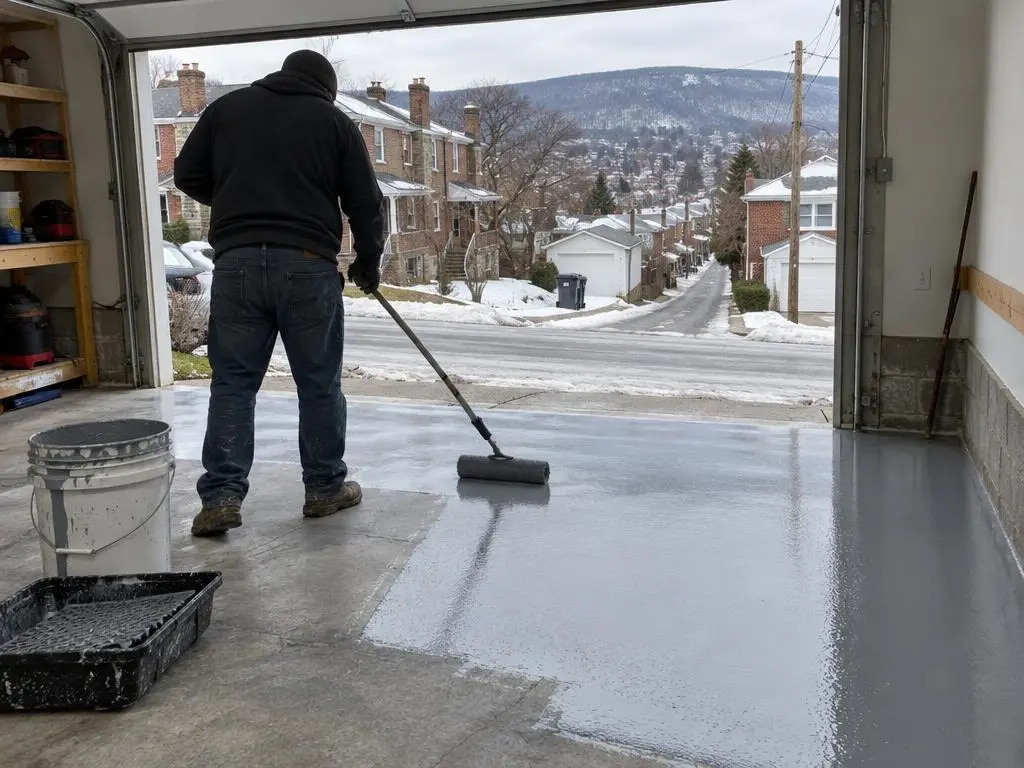
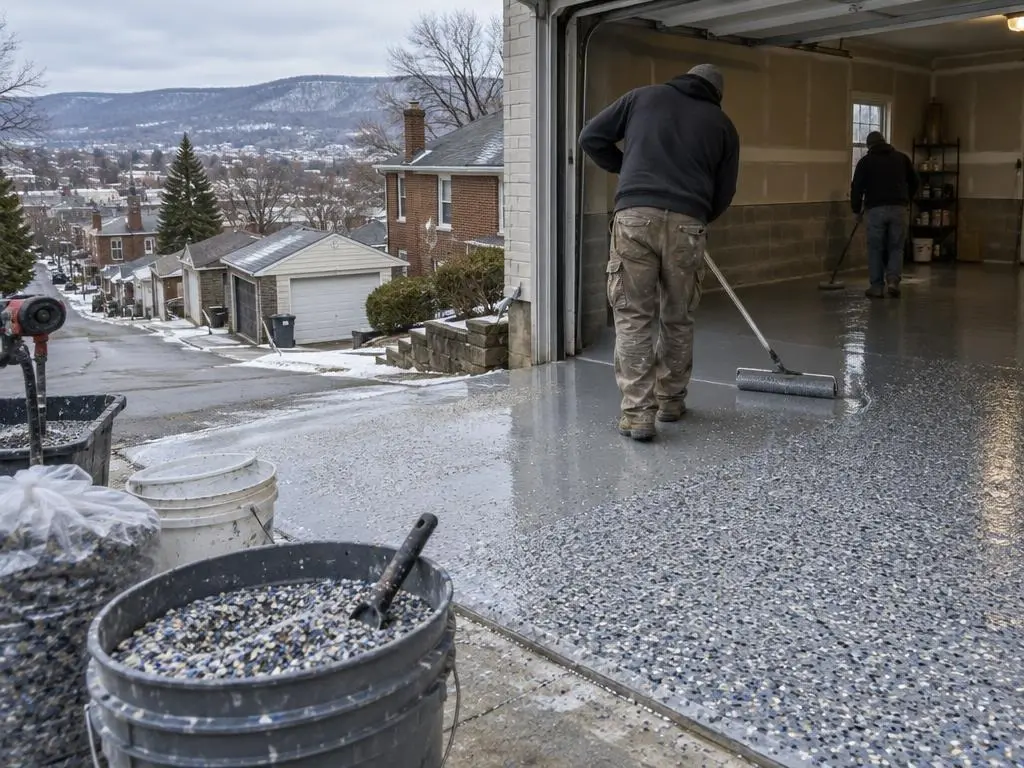
A full polyaspartic system uses polyaspartic for the base, the flake or color layer and the topcoat. It can often be finished in a single day, and you can park the next day. A hybrid uses an epoxy base, which bonds deeply and tolerates more surface variation, under a polyaspartic topcoat. We choose between them based on the slab, the moisture reading, the temperature and how soon you need the space back.
Installing in the shoulder seasons
Spring and fall in the Lehigh Valley bring cold mornings and mild afternoons. Epoxy needs the slab and air to stay warm long enough to cure, and cold slows it down. Polyaspartic cures across a much wider temperature range, so it widens the window for garage work in October, November and March. The slab still has to be dry and above the dew point so moisture does not condense on it, and we check that with a thermometer before we start.
The trade-off: speed
Polyaspartic sets fast, which means it has to be mixed in smaller batches and applied by an experienced crew. That is part of why HomeGuide's range for it, $5 to $12 per square foot, runs higher than epoxy's. The fast cure also makes surface prep even more important. There is no time to fix a contaminated or poorly ground spot once the coating is down, so we grind the whole floor and repair cracks before we open the first kit.
Where we use it most
- Garages where the owner needs to park again within a day or two
- Floors that get afternoon sun through an open door or windows
- Fall and early-spring jobs when temperatures are marginal for epoxy
- Topcoats over flake and solid-color epoxy floors
- Small commercial spaces that cannot close for a week
What This Covers
A polyaspartic job includes the same preparation as any coating, plus a system matched to your timeline.
Slab prep and repair
Diamond grinding, crack and spall repair, and oil treatment before any coating.
Full polyaspartic system
Base, flake or color, and topcoat all in polyaspartic, typically finished in a day.
Epoxy base, polyaspartic top
A deep-bonding epoxy base under a UV-stable, abrasion-resistant polyaspartic topcoat.
Topcoat refresh
A new polyaspartic topcoat over a sound older coating that has dulled or yellowed.
Typical Polyaspartic Floor Coating Costs
| Item | Published range |
|---|---|
| Per square foot (HomeGuide) | $5 to $12 |
| Per square foot (Bob Vila) | $4 to $9 |
| One-car garage (288 to 392 sq ft) | $1,400 to $4,700 |
| Two-car garage (400 to 576 sq ft) | $2,000 to $6,900 |
| Three-car garage (576 to 864 sq ft) | $2,900 to $10,400 |
| Moisture barrier, if needed | about $1 more per sq ft |
National ranges from HomeGuide and Bob Vila. Local prices differ, and repairs, old coatings, flake and moisture work all change the total. Your written estimate is the price.
How It Works
1. Assess the floor and timing
We test moisture and temperature, measure the slab and ask when you need it back.
2. Prepare
Diamond grinding, crack and joint repair, and vacuuming of all dust.
3. Apply in small batches
Base, color or flake, and topcoat mixed and applied in controlled batches.
4. Return to service
Walk on the floor in hours and park in about a day, with exact times written for you.
Polyaspartic Floor Coating Questions
Is polyaspartic better than epoxy for a garage?
It cures faster and resists UV better, and HomeGuide gives it a wider application temperature range. Epoxy builds thicker and costs less. Many floors combine the two, with an epoxy base under a polyaspartic topcoat.
How much does polyaspartic cost for a two-car garage?
HomeGuide lists $2,000 to $6,900 for a 400 to 576 square foot garage. Repairs, old coating removal and flake choices move the price within that range.
Can polyaspartic go down in cold weather?
It cures across a much wider range than epoxy, so fall and early-spring jobs are workable. The slab still has to be dry and above the dew point, which we check before starting.
How long does a polyaspartic floor last?
HomeGuide puts polyaspartic coatings at 10 to 20+ years. How long yours lasts depends on prep, traffic and how often salt and chemicals sit on the surface.
Polyaspartic Floor Coating Service Areas
- Epoxy Flooring in Bethlehem, PA
- Epoxy Flooring in Allentown, PA
- Epoxy Flooring in Easton, PA
- Epoxy Flooring in Hellertown, PA
- Epoxy Flooring in Fountain Hill, PA
- Epoxy Flooring in Bethlehem Township, PA
- Epoxy Flooring in Hanover Township, PA
- Epoxy Flooring in Lower Saucon Township, PA
- Epoxy Flooring in Upper Saucon Township, PA
- Epoxy Flooring in Salisbury Township, PA
- Epoxy Flooring in Freemansburg, PA
- Epoxy Flooring in Whitehall Township, PA
- Epoxy Flooring in Catasauqua, PA
- Epoxy Flooring in Northampton, PA
- Epoxy Flooring in Bath, PA
- Epoxy Flooring in Nazareth, PA
- Epoxy Flooring in Upper Nazareth Township, PA
- Epoxy Flooring in Palmer Township, PA
- Epoxy Flooring in Forks Township, PA
- Epoxy Flooring in Emmaus, PA
- Epoxy Flooring in Lower Macungie Township, PA
- Epoxy Flooring in Upper Macungie Township, PA
- Epoxy Flooring in Coopersburg, PA
Get a Polyaspartic Floor Coating Estimate
Ask about a fast-return polyaspartic floor at your free estimate.