
Attached, detached and alley garages
Garage Floor Coating in Bethlehem, PA
A sealed slab you can squeegee clean after every storm, built on concrete that has been ground and repaired first.
- Free on-site estimate with a slab moisture test
- Itemized written quote that lists every coat
- Concrete ground and repaired before any coating
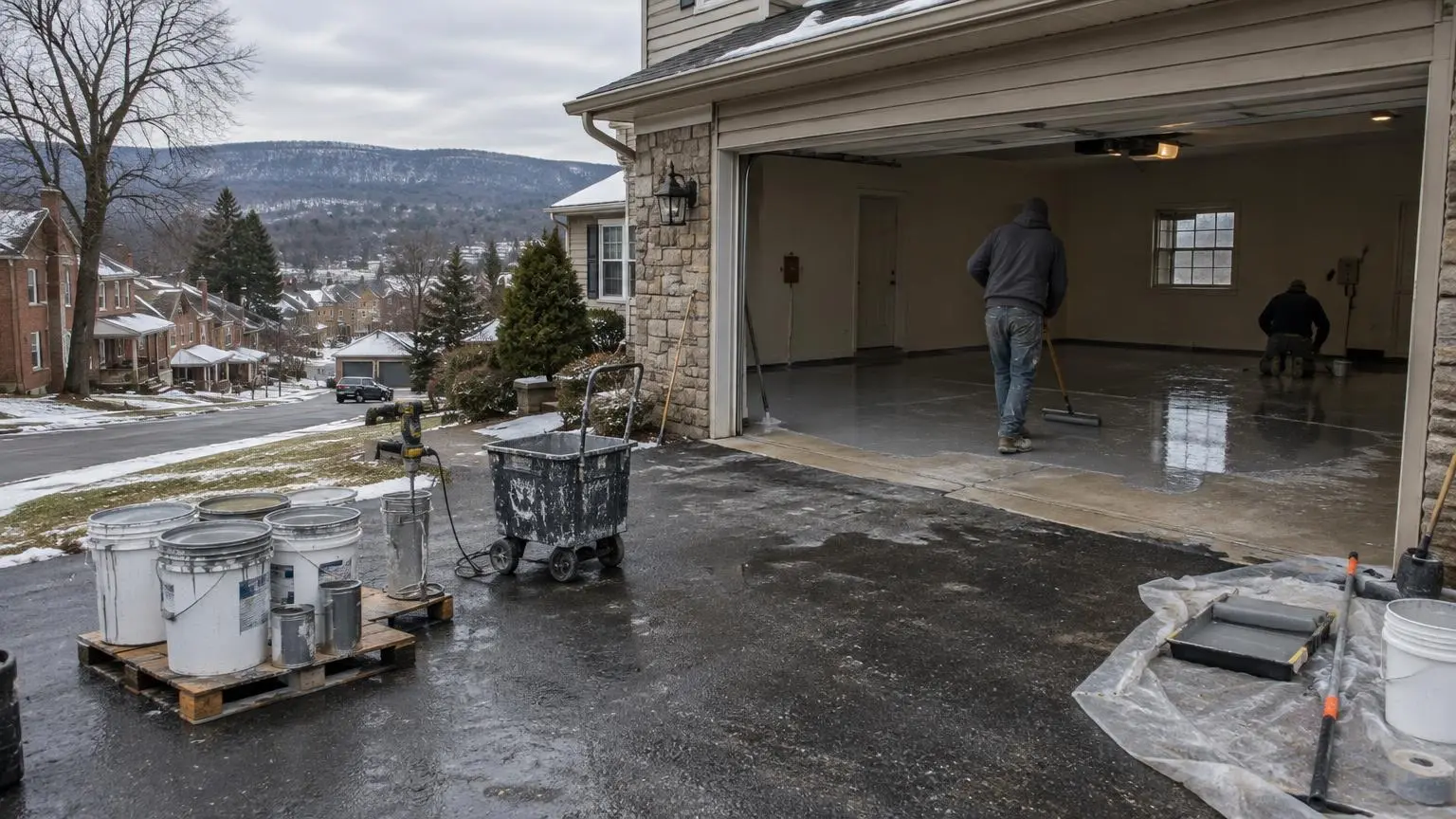
Garage Floors That Hold Up to Pennsylvania Winters
Garage floor coating protects the floor that takes the hardest wear in most Bethlehem homes, because the garage is where winter does its damage. Snow and brine come in on the car, melt into puddles under the tires and soak into the concrete. The Allentown airport averages 33.1 inches of snow a season, and January highs in Bethlehem average 37°F, so that wet concrete freezes and thaws over and over. After a few seasons the slab starts to flake near the door, pit under the wheels and shed dust that comes back after every sweep. A coating seals the surface so meltwater sits on top, where you can push it out the door.
The garages we see around Bethlehem
The city's housing spans more than a century. Point2Homes' summary of 2019 to 2023 census data shows 31.3% of Bethlehem homes built in 1939 or earlier and a median year built of 1957. That gives us three common garage types:
- Detached alley garages behind twins and rowhouses, often single-bay, with older and thinner concrete that may slope toward the door or hold water.
- Attached one- and two-car garages on postwar ranches and split-levels, with slabs that have taken decades of winter salt.
- Newer attached garages in the townships that grew fastest after 2000, such as Forks, Upper Nazareth and Upper Saucon, where the slab is usually sound but still faces the same brine.
Each one needs different prep, which is why we do not quote from a phone call.
Why salt is hard on bare concrete
Concrete is porous. Brine wicks into the top layer, and when it freezes the expanding ice and the salt crystals push the surface apart. The first few feet inside the door get the most meltwater and the widest temperature swings, so the damage starts there. Oil and antifreeze drips add stains that soak in and later keep a coating from bonding. A sealed, continuous floor stops both problems at the surface.
Signs it is time to coat
- Flaking or scaling inside the door and in the tire paths
- White salt rings where puddles have dried
- Oil stains that no cleaner lifts
- Concrete dust that settles on everything stored in the garage
- A store-kit coating peeling off where the tires sit
- Cracks, chipped control joints or low spots where water stands
Preparation is most of the job
The usual reason a garage coating fails is that it never bonded. Kit products rely on acid etching, which cleans the top of the slab but leaves weak, salt-damaged concrete and old sealers in place. Hot tires then lift the coating. We diamond grind the entire floor, edges included, with a vacuum attached to the grinder. Then we degrease oil spots, fill cracks and spalls, and grind the patches flush. If there is old paint or a failed kit coating, it all comes off first.
Picking a finish
Many homeowners choose a full flake floor because it hides salt film and grit between cleanings and gives tires and boots some grip. Others prefer a solid color with a light flake scatter or an anti-slip additive in the topcoat. Over either one, a polyaspartic topcoat adds UV stability, which matters if your garage door stays open on summer afternoons, and lets you park sooner. We bring chip and color samples to the estimate so you can see them in your own garage light.
Winter care for a coated floor
A coating makes brine easy to remove, but brine left for weeks will still dull a topcoat. Keep a floor squeegee by the door, rinse the floor a few times through the salt season, and consider containment mats under each car. Use a plastic shovel on the coated surface, never a metal-edged one.
What This Covers
A garage floor coating covers the full slab, from the door threshold to the back wall and into the corners.
Full-floor diamond grinding
The whole slab and its edges ground to remove flaking, salt-contaminated concrete and old sealers.
Crack, spall and joint repair
Cracks and pitted areas filled; control joints filled or left open, depending on the look you want.
Base, color or flake, and topcoat
A bonded base coat, a solid color or flake broadcast, and a clear chemical-resistant topcoat.
Stem walls and steps
Coating can be carried up the short concrete curb along the walls and onto steps into the house.
Old coating removal
Peeling kit epoxy, floor paint and sealers ground off down to sound concrete before anything new goes on.
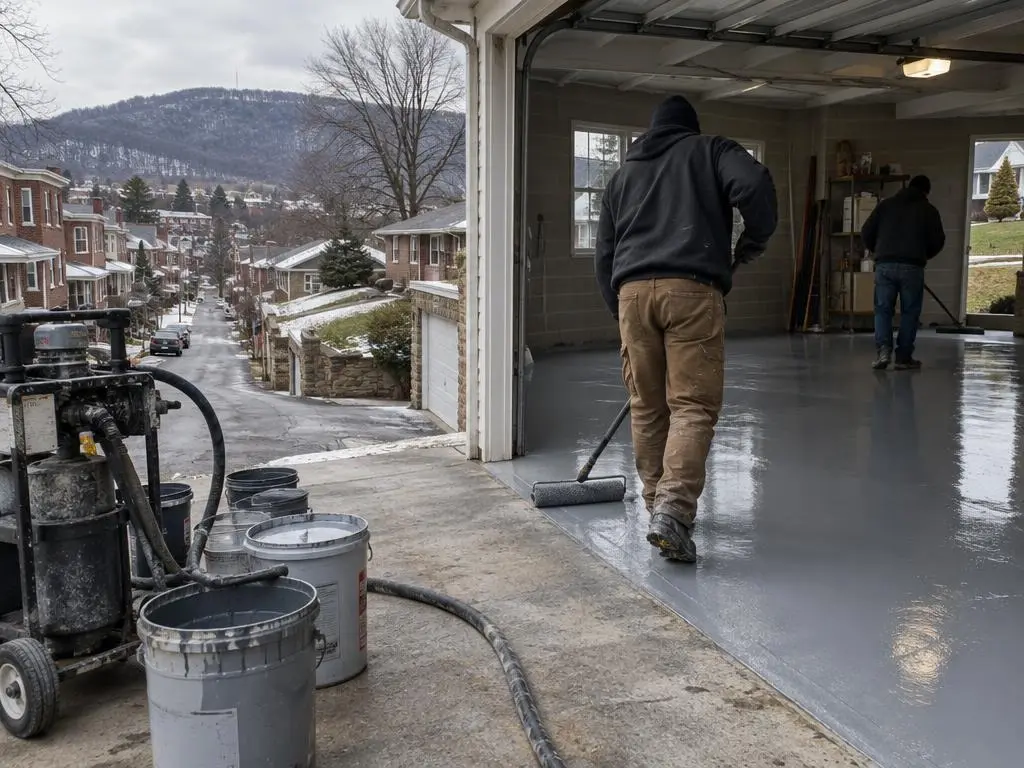
Typical Garage Floor Coating Costs
| Garage | Published range |
|---|---|
| Installed epoxy, per square foot | $4 to $10 |
| One-car garage (288 to 392 sq ft), epoxy | $1,200 to $3,900 |
| Two-car garage (400 to 576 sq ft), epoxy | $1,600 to $5,800 |
| Three-car garage (576 to 864 sq ft), epoxy | $2,300 to $8,600 |
| Two-car garage, polyaspartic | $2,000 to $6,900 |
| Patching cracks and chips | $25 to $250 |
National ranges from HomeGuide (epoxy and polyaspartic cost guides) and HomeAdvisor (patching). Bethlehem prices can differ, and salt damage, old coatings and the finish you choose change the total. Your written estimate is the price.
How It Works
1. Estimate
We measure, test the slab and note flaking, cracks, oil and any old coating, then write up the quote.
2. Grind and repair
Dust-controlled diamond grinding of the whole floor, then cracks and spalls filled and ground flush.
3. Coat
Base coat, color or flake, and topcoat, applied in one or two days depending on the system.
4. Cure and return
We give you written times for walking, moving items back and parking, based on the product and the temperature.
Garage Floor Coating Questions
How much does a garage floor coating cost in Bethlehem?
HomeGuide puts a two-car garage at about $1,600 to $5,800 for epoxy and $2,000 to $6,900 for polyaspartic. Salt damage, old coatings that have to come off and the finish you pick move the price. We give you a written number after seeing the floor.
Can you coat a small detached garage off an alley?
Yes. We need to get a grinder and vacuum to the door, and power within reach of a cord. Small garages still carry setup and material minimums, so the price per square foot is usually higher than for a large attached garage.
How long until I can park on the new floor?
Bob Vila's guides say about 24 hours for polyaspartic and around three days for standard epoxy before vehicles. HomeGuide gives a range of two to seven days for driving on epoxy. We give you a specific time for your floor based on the product and temperature.
Why did my store-bought garage epoxy peel?
Almost always prep. Kits rely on acid etching, which leaves weak, salty concrete and sealers in place, and hot tires lift the thin film. A ground slab and a thicker system bond much better.
Garage Floor Coating Service Areas
- Epoxy Flooring in Bethlehem, PA
- Epoxy Flooring in Allentown, PA
- Epoxy Flooring in Easton, PA
- Epoxy Flooring in Hellertown, PA
- Epoxy Flooring in Fountain Hill, PA
- Epoxy Flooring in Bethlehem Township, PA
- Epoxy Flooring in Hanover Township, PA
- Epoxy Flooring in Lower Saucon Township, PA
- Epoxy Flooring in Upper Saucon Township, PA
- Epoxy Flooring in Salisbury Township, PA
- Epoxy Flooring in Freemansburg, PA
- Epoxy Flooring in Whitehall Township, PA
- Epoxy Flooring in Catasauqua, PA
- Epoxy Flooring in Northampton, PA
- Epoxy Flooring in Bath, PA
- Epoxy Flooring in Nazareth, PA
- Epoxy Flooring in Upper Nazareth Township, PA
- Epoxy Flooring in Palmer Township, PA
- Epoxy Flooring in Forks Township, PA
- Epoxy Flooring in Emmaus, PA
- Epoxy Flooring in Lower Macungie Township, PA
- Epoxy Flooring in Upper Macungie Township, PA
- Epoxy Flooring in Coopersburg, PA
Get a Garage Floor Coating Estimate
Free on-site garage floor estimates in Bethlehem and the Lehigh Valley.